
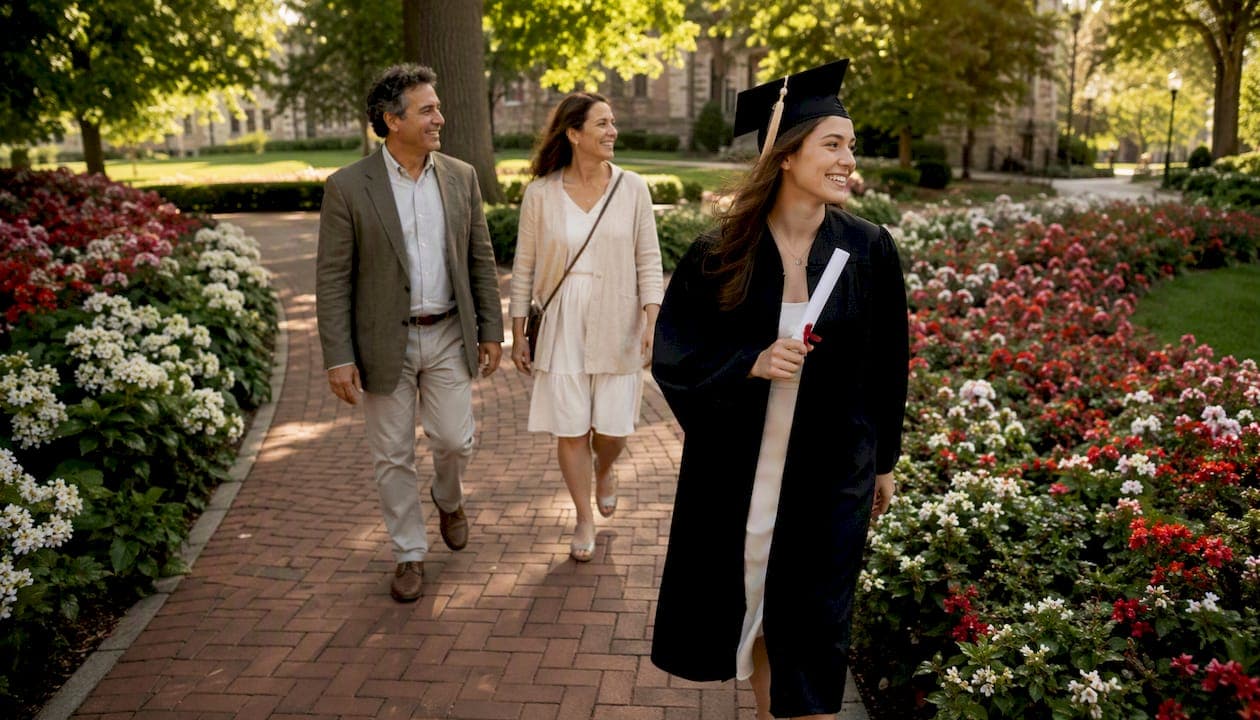
Here are ten family graduation photo ideas that work for almost any family shape or size: a settling shot with the graduate alone, one‑on‑one pairings with each parent, a full formal group, a multi‑generational portrait with grandparents, a sibling‑only set, a walking or "leaving the ceremony" shot, a cap‑toss or celebration burst, a detail shot of the gown and diploma, a candid laughter moment nobody poses for, and a relaxed close‑up hug between the graduate and whoever means the most to them. These work because they mix formal structure with unscripted moments, which is exactly what separates a gallery people flick through once from one they actually keep. The images families treasure most are rarely the stiffest ones; they tend to be the small, unplanned moments sitting alongside the tidy group shots.
On outfits, the rule is simple: coordinate, don't match. Pick a shared palette and let everyone wear their own version of it, rather than identical colours or patterns.
- Solo graduate portrait (cap, gown, gaze to camera or slightly off)
- Graduate with each parent individually
- Full immediate family group
- Multi‑generational shot with grandparents or mentors
- Siblings only, with and without the graduate
- Walking or candid movement shot
- Cap‑toss or celebratory burst
- Detail shot: diploma, cords, cap close‑up
- Unscripted laughter or embrace
- One quiet, close portrait with the person the graduate is closest to
Screenshot this list now, or save the page. Further down, you'll find a printable version with time estimates for each shot, plus the outfit and prop guidance that makes these ten ideas actually look good together, rather than like ten disconnected snaps.
Key Takeaways
Family graduation photos work best when formal group shots are paired with unscripted candid moments, coordinated (not matching) outfits, and a pre-agreed shot list that prioritises key family groupings first.
| Point | Details |
|---|---|
| Save the ten‑shot list | Screenshot or print the opening list so nobody has to recall the running order on the day. |
| Coordinate, don't match | Pick a shared palette and let each family member wear their own version of it. |
| Prioritise key groupings first | Shoot graduate solo, then with each parent, then grandparents, before larger or candid shots. |
| Build in buffer time | Add a twenty minute travel buffer and a ten minute outfit buffer between locations. |
| Consider a professional session | A pre‑session consultation with a photographer such as Pixels Pro covers outfits, props and shot priorities in advance, reducing on‑the‑day stress. |
Table of Contents
- Family graduation photos: pose ideas by mood and family size
- Coordinating outfits without looking like a matching set
- Props and personal touches that add real storytelling value
- Where and when to shoot family graduation photos
- Adjusting for different family sizes and ages
- Session prep and a printable shot list
- Shooting family graduation photos on a phone
- What a professional graduation session typically includes
- What actually matters on the day
- How Pixels Pro helps with family graduation photos
- Frequently asked questions
- Sources
Family graduation photos: pose ideas by mood and family size
Not every shot needs the same energy. Splitting the session into moods, rather than trying to nail every pose in one continuous block, keeps everyone relaxed and gives you a gallery with genuine range.
Formal and classic poses
These are your anchor images, the ones that end up framed. Stand the graduate centre, parents flanking on either side, hands relaxed rather than clasped. For couples with the graduate, try a slight turn toward each other rather than square‑on to camera. It reads far less stiff.
- Graduate flanked by both parents, everyone's weight on the back foot, chins slightly lifted
- One‑on‑one with each parent, graduate looking at the parent rather than the lens
- Grandparents seated, graduate standing behind, a hand on each shoulder
- Full family line‑up, tallest to shortest works better than by age
Candid and moment‑driven shots
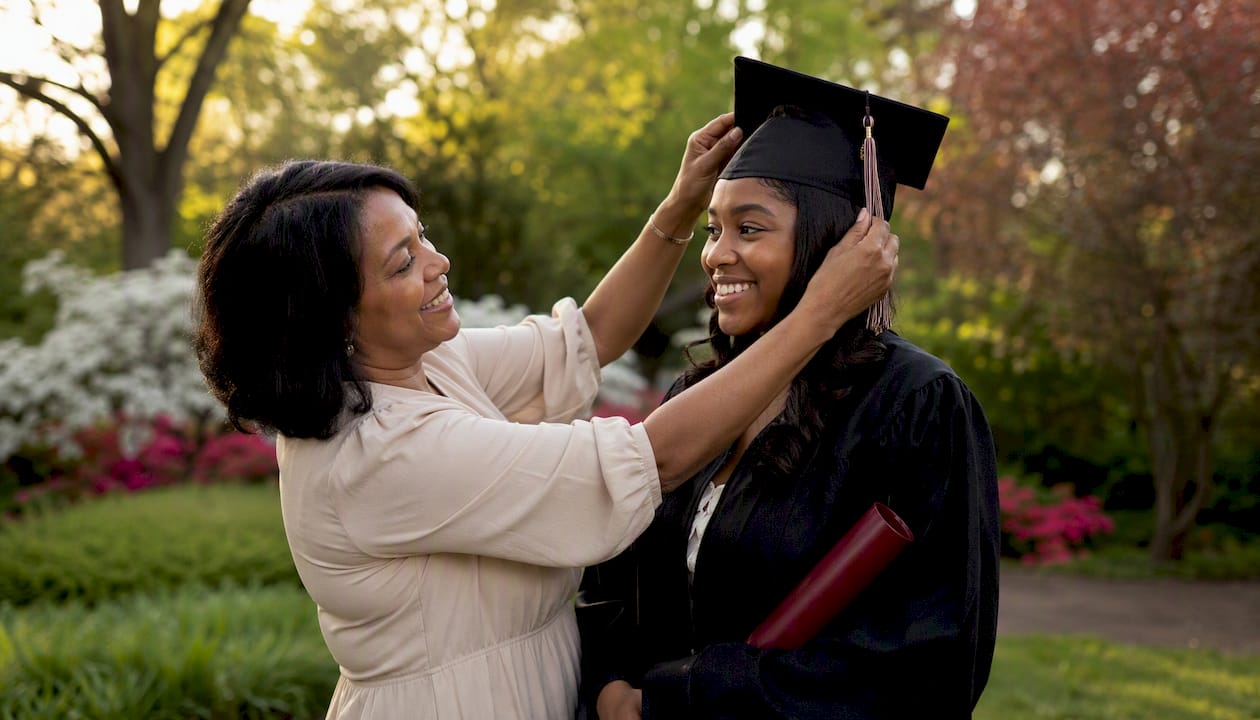
The best graduation photographs often feel real rather than staged. Parents adjusting a tassel, a sibling whispering a joke, laughter catching mid‑breath. None of this needs choreography. It needs a photographer (or a phone‑holding relative) ready to fire off frames while everyone else just talks.
- Fixing the cap or gown, shot from a slight angle so hands are visible
- Mid‑laugh reaction, triggered by an inside joke or a genuinely funny prompt
- Someone whispering something to the graduate, captured from the side
Walking and action shots
Movement injects life into a session that can otherwise feel like a series of stills. Have the family walk toward the camera in loose conversation, or the graduate walking ahead while parents watch from behind. Leading lines, campus paths, a row of trees, work brilliantly here because they draw the eye straight to the group without needing a posed centre point.
Celebratory and multi‑generational shots
Cap tosses, group hugs, grandparents holding a framed photo of the graduate as a baby next to the graduate now. Photography that includes siblings, grandparents or mentors consistently produces the images families rate as most meaningful years later, more so than the solo formal portrait most people assume will be the keeper.
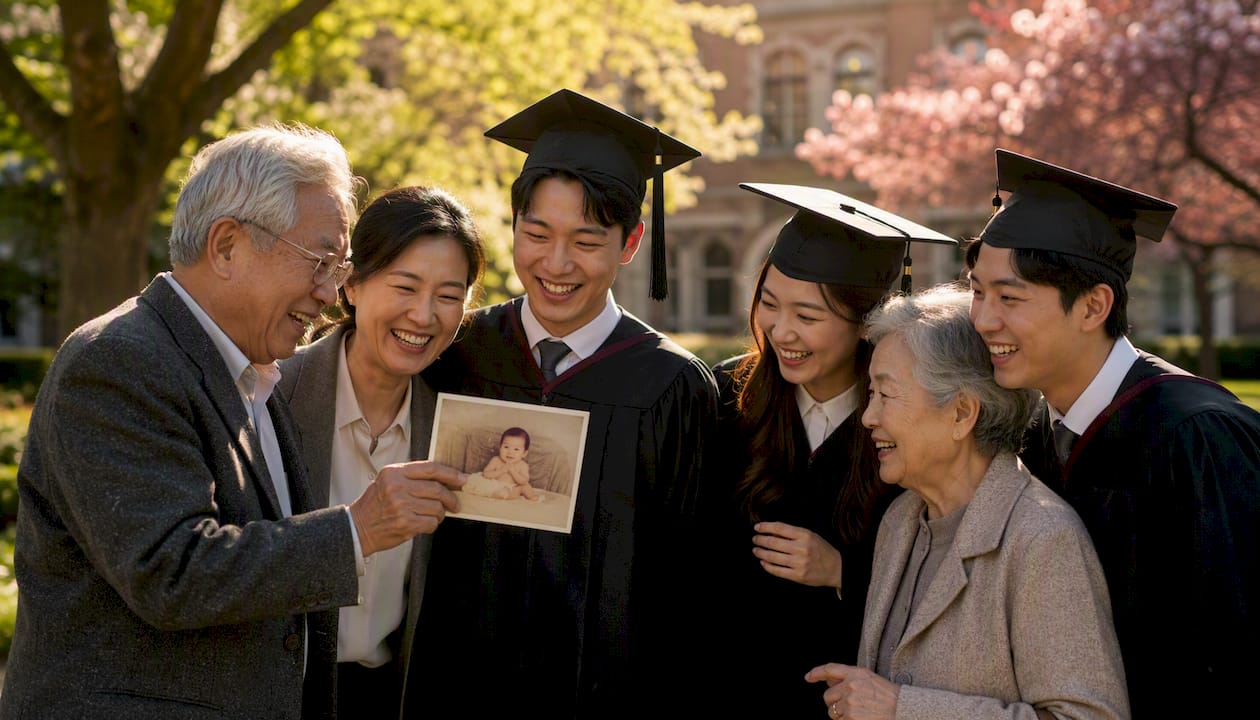
For composition, keep negative space above heads generous in outdoor shots (it gives the image room to breathe) and use gowns as natural leading lines when several graduates or siblings stand in a row.
Pro Tip: Ask a genuinely embarrassing question right before the shutter clicks, something like "what was the graduate's most ridiculous nickname at seven years old". You get real laughter, not a held smile that starts to look strained by frame three.
Pro Tip: Photograph the same grouping twice, once fully posed and once immediately after you say "relax", camera still rolling. The second frame is often the better one.
Coordinating outfits without looking like a matching set
Coordinate the palette, not the outfit. Pick two or three complementary tones and let each family member wear their own interpretation, rather than putting everyone in the same navy polo. Coordinated colour with varied texture photographs noticeably better than a uniform look, and it avoids the slightly awkward "school photo day" effect that head-to-toe matching produces.
What to avoid:
- Large logos or text across the chest, they date the photo and pull focus
- Busy patterns on more than one person at a time, they compete with each other in group shots
- Identical outfits worn by everyone, it reads as costume rather than family
Palette ideas that work well:
- Neutral base, one accent colour — cream, tan and soft grey with a single family member in burgundy or forest green
- Soft pastels — works particularly well for spring ceremonies and outdoor golden hour light
- Jewel tones for autumn shoots — deep teal, plum and mustard photograph beautifully against warm October light
Fabric matters more than most people expect. Flowy cotton or linen drapes better than stiff synthetic blends, particularly for anyone standing for group shots in a breeze. Structured blazers photograph sharply on fathers and grandfathers; a soft shawl does the same job for grandmothers who might feel exposed in short sleeves.
Packing checklist for the day:
- Spare shoes for anyone walking across grass or gravel
- A lint roller (gowns pick up everything)
- Safety pins for a stray hem or a gaping shirt
- A blazer for dad, easy to put on or shed depending on temperature
- A shawl or cardigan for grandparents who chill quickly outdoors
Props and personal touches that add real storytelling value
Props work when they mean something, not when they're just there to fill a hand. A cap, an honours cord, a diploma cover, a bouquet, or a small family heirloom all add texture to a photo without turning it into a prop shoot.
Good options include the graduation cap itself (held rather than worn, for a change of angle), stoles or cords that signal an achievement, a framed baby photo held next to the graduate now, and a club or team scarf for anyone with a strong extracurricular identity. A grandparent's old university scarf, if it exists, is the kind of detail that turns an ordinary portrait into a two‑generation story in one frame.
Use props in both posed and candid shots. In posed images, keep the prop still and let the graduate's expression do the work. In candid shots, let someone hand the prop over mid‑motion, a bouquet passed from mother to graduate, a diploma tucked under an arm while walking, rather than holding it static for the camera.
A quick safety and accessibility note matters here. Keep small props, framed photos, loose flowers, off the ground where an older relative with a mobility aid might catch a foot, and keep anything breakable well away from toddlers who will grab first and ask questions never.
Pro Tip: If a prop carries a family story, a father's old varsity jacket, a grandmother's brooch, shoot it twice: one tight detail shot of the object alone, then a wider group shot including it. Paired together in a gallery or album, that sequence tells a story a single wide shot never could.
Where and when to shoot family graduation photos
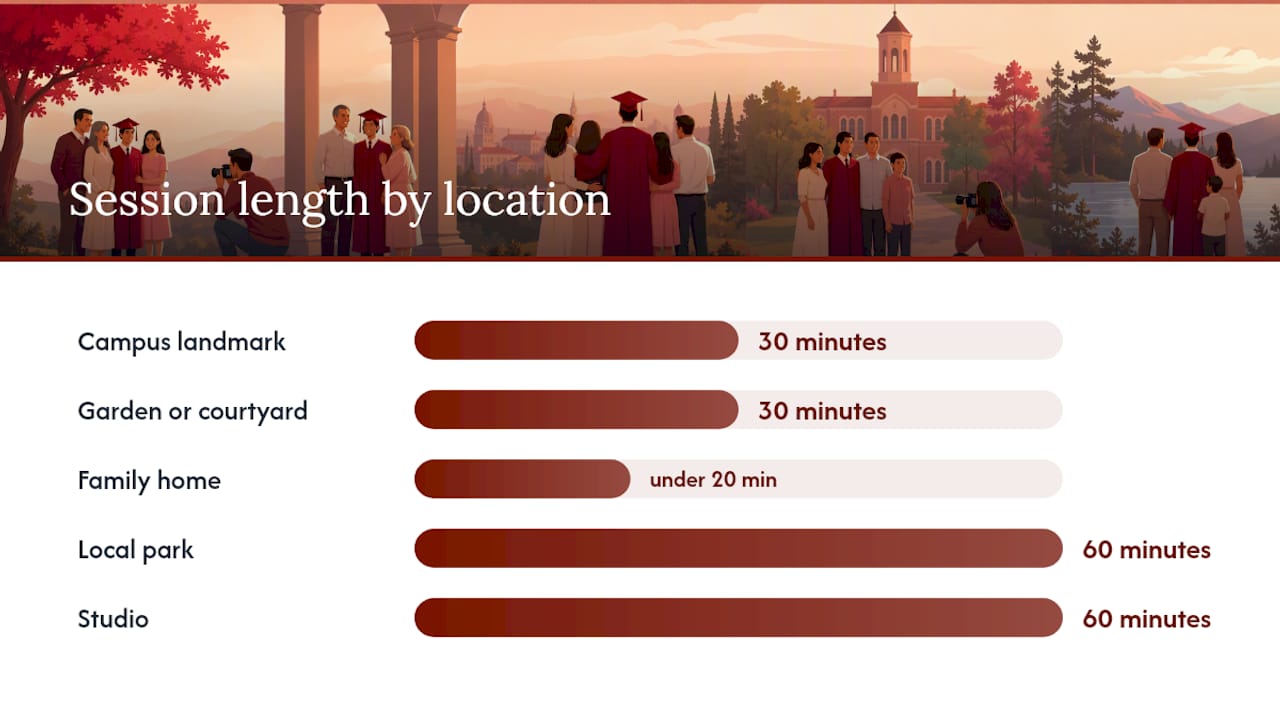
Location sets the mood before a single pose is chosen. A campus landmark gives you architecture and scale. A garden or courtyard gives you soft, even light and greenery that flatters every skin tone. A family home adds intimacy and personal detail. A local park offers open space for large groups and walking shots. A studio gives you total control over light and background, useful if the weather forecast looks unreliable or if several family members have mobility needs that make an outdoor location impractical.
Timing shapes everything else. Shooting before the ceremony means fresher outfits, calmer nerves and a graduate who isn't yet drained from hours of sitting in the heat. Shooting after means genuine post‑ceremony relief and celebration on faces, but rumpled gowns and less patience for a long session. Golden hour, roughly the hour after sunrise or before sunset, gives the warmest, most flattering light for outdoor portraits, though graduation timing rarely lines up conveniently with sunset. Build in a buffer of at least twenty minutes for travel between the ceremony venue and your chosen photo location, and another ten for outfit adjustments.
| Location type | Best time | Approx. session length | Weather consideration |
|---|---|---|---|
| Campus landmark or steps | Late afternoon, avoiding midday sun | 30 minutes | Exposed; have a shaded backup nearby |
| Garden or courtyard | Golden hour or overcast days | 30 minutes | Soft light works even in cloud |
| Family home | Any time, flexible | under 20 minutes | Fully weatherproof indoors |
| Local park | Morning or golden hour | 60 minutes | Check for wind on gowns and hats |
| Studio | Any time, fully controlled | 60 minutes | No weather risk at all |
A few logistics worth confirming in advance: check whether your chosen campus location needs a permit for group photography, scout parking near the site rather than assuming there will be spaces, and avoid the thirty minutes immediately after a ceremony ends when every other family has the same idea. Keep a studio or indoor option in your back pocket if rain is even a slight possibility. Photographers who offer both studio and on‑location sessions often build that flexibility into their packages precisely because British weather rarely commits to a plan a week in advance.
Adjusting for different family sizes and ages
A small nuclear family (graduate plus two parents) can move through the full shot list in under twenty minutes, formal, candid, walking, done. A large extended family, aunts, uncles, cousins, in‑laws, needs a running order agreed beforehand, because herding fifteen people into a group shot eats time fast if nobody's briefed in advance.
When the group includes grandparents or great‑grandparents, multi‑generational portraits become the priority shot, not an afterthought squeezed in at the end. If siblings are part of the mix, a sibling‑only set (no parents, no graduate as the sole focus) is often the shot families didn't know they wanted until they see it in the gallery.
If time is tight, shoot in priority order: graduate solo, graduate with each parent, then grandparents, then the wider group, then candid and walking shots last. That sequencing means the images that matter most are locked in even if the session gets cut short by weather or a restless toddler.
Toddlers and young children do best with short bursts of attention rather than long directed poses, a favourite toy or a small snack nearby keeps them engaged far longer than instructions ever will. Older relatives benefit from a seated option for every standing pose you've planned; agreeing this in advance means nobody has to awkwardly negotiate a chair mid‑shoot. If anyone in the family uses a mobility aid, a wheelchair, a cane, a walking frame, plan the composition around it rather than trying to hide it. A grandparent seated centrally with the family gathered around reads as warm and natural, not as a workaround.
Session prep and a printable shot list
A pre‑session conversation about outfits, props and priority shots consistently produces calmer sessions and stronger galleries, largely because nobody is improvising decisions on the day itself. Run through this list the morning of the shoot, and keep a printed or screenshotted copy on hand.
- Solo graduate portrait (cap and gown, 2 to 3 minutes)
- Graduate with mother (2 minutes)
- Graduate with father (2 minutes)
- Full immediate family group (3 to 4 minutes)
- Graduate with siblings (3 minutes)
- Multi‑generational shot with grandparents (3 to 5 minutes)
- Extended family or large group (5 minutes, more if the group is large)
- Walking or action shot (2 to 3 minutes)
- Cap‑toss or celebratory burst (2 to 3 minutes, allow two attempts)
- Detail shots: diploma, cords, cap close‑up (2 minutes)
- Unscripted candid moment, no direction given, just wait (open ended)
Before the shoot, confirm a meeting point, exchange phone numbers with anyone travelling separately, and settle outfit choices at least a day ahead rather than the morning of. Build in a ten minute buffer between each numbered item above; sessions almost always run slightly long once family members start chatting.
Pro Tip: Screenshot this list now. On the day, hand it to whoever's holding the camera, professional or family member, so nobody has to remember the running order from memory.
Once the shoot wraps, ask about turnaround time. Professional sessions typically deliver an online gallery within one to three weeks, with prints or albums available as a follow‑on order once you've chosen your favourites.
Shooting family graduation photos on a phone
If a professional session isn't part of the plan, a phone can still produce genuinely good results with a few adjustments. Lock exposure by tapping and holding on a face rather than letting the camera guess. Tap to focus directly on whoever's meant to be sharpest, usually the graduate. Use portrait mode for smaller groupings where background blur adds depth, but switch it off for larger groups since it can blur people standing at the edges. Avoid digital zoom entirely; step closer instead; digital zoom degrades image quality fast.
For composition, shoot from eye level or very slightly above for flattering angles, particularly with larger groups where a low angle can distort proportions. Use the rule of thirds to place the graduate off‑centre rather than dead middle, and look for something in the foreground, a branch, a railing, a shoulder, to frame the shot and add depth.
- Clean the camera lens before you start, pocket lint ruins more phone photos than bad light ever does
- Charge to at least 80% and bring a portable charger
- Clear storage space in advance, group shoots generate more images than you expect
- Use burst or continuous shooting mode for anything with movement, a cap toss, a hug, a laugh
Pro Tip: Burst mode is the single biggest upgrade you can make to phone photography for family shoots. Fire it during the cap toss, the hug, the walk toward camera, then pick the one frame afterwards where everyone's expression actually lands.
What a professional graduation session typically includes
Hiring a professional photographer changes the shoot in ways that go beyond image quality. Most professional graduation packages open with a pre‑session consultation covering outfits, props, priority shots and location, then move into the session itself with a photographer directing poses and reading the group's energy in real time, followed by hand‑editing and delivery through an online gallery. Pre‑session consultations that cover outfits, props and a shot list tend to produce noticeably more polished, stress‑free galleries than sessions where families turn up and improvise.
Packages are typically tiered, from a compact single‑location session through to more comprehensive coverage that includes both studio and outdoor portraits, with a set number of hand‑edited images and options to add prints or albums afterwards.
Families who bring extended relatives into the frame, siblings, grandparents, mentors, consistently describe the resulting multi‑generational portraits as among the images they value most years later, often more than the solo formal shot they assumed would be the highlight.
When booking, ask specific questions: what's the turnaround time for the edited gallery, how many finished images are included, do you retain print rights or does the photographer, what's the cancellation and reschedule policy if the ceremony date shifts, and does the photographer carry insurance. Before booking anyone, look through a portfolio to judge consistency of style and whether their editing tone matches what you actually want on your wall.
What actually matters on the day
A typical family graduation shoot starts predictably: everyone slightly stiff, parents fussing with the gown, a graduate half embarrassed by the whole thing. Then somewhere around the fifth or sixth frame, something loosens. A grandmother makes a joke nobody expected, or a sibling pulls a face behind the graduate's back and the whole group cracks up mid‑pose. That frame, the one nobody planned, is usually the one that ends up printed and framed, not the perfectly symmetrical formal shot everyone stood still for.
The temptation with a milestone this big is to over‑plan, to try to script every expression and every angle in advance. Planning matters, a shot list genuinely does reduce stress and missed opportunities, but the best images tend to come from relaxed interaction rather than rigid direction. Build the structure, then leave enough room in the schedule for the unplanned moment to happen. It usually does.
How Pixels Pro helps with family graduation photos
Planning gets you most of the way there, but a professional session still closes the gap between "nice photos" and images you'll actually want printed and framed. Pixels Pro runs family and graduation sessions from a Coventry base, with both studio and on‑location options depending on what suits your group, a pre‑session consultation to plan outfits and priority shots before anyone shows up, and hand‑edited images delivered through an online gallery afterwards.
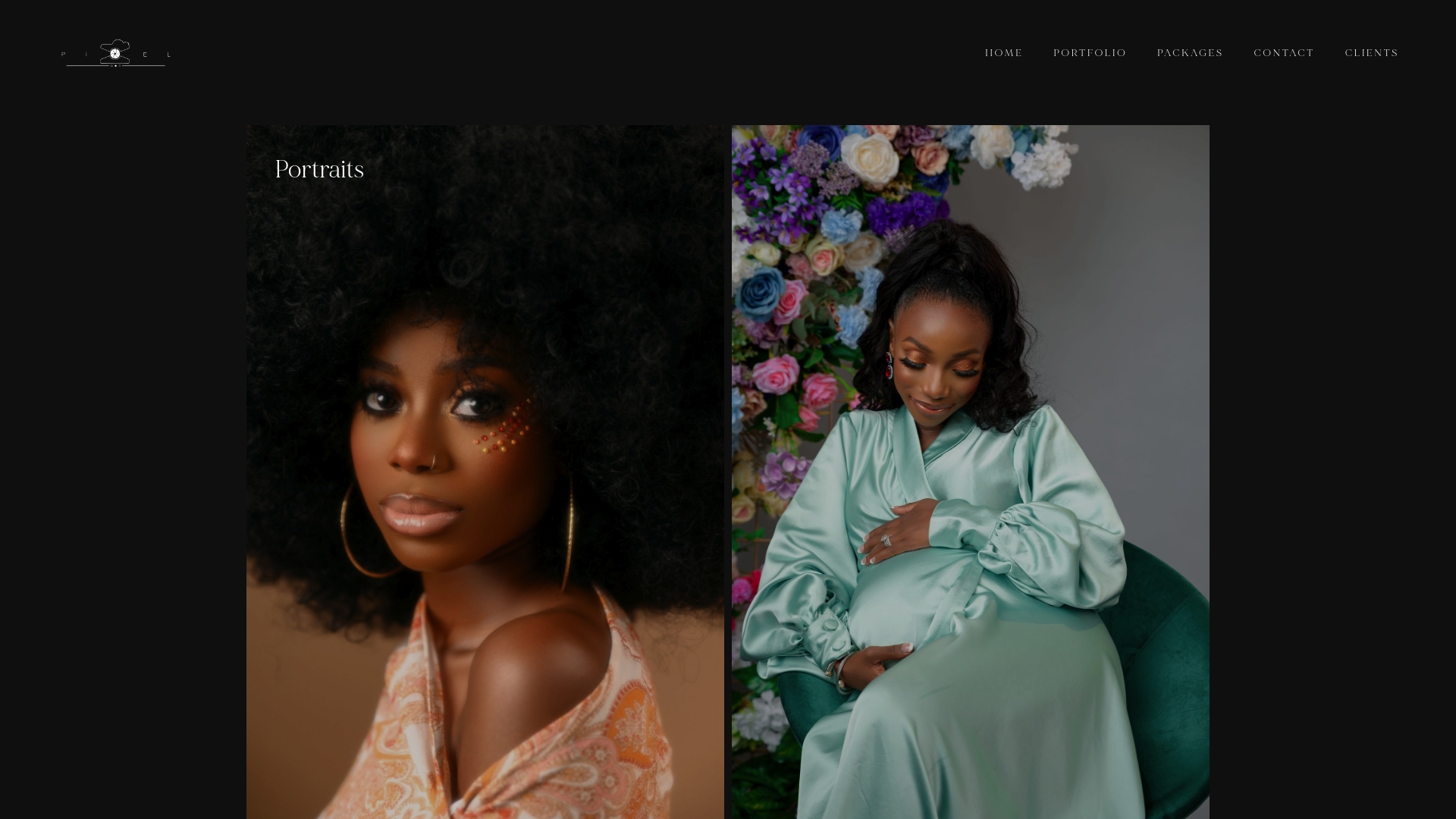
If you want a sense of style before committing, the portfolio shows real family and graduation sessions rather than stock examples, and the graduation services page sets out how a typical session runs from consultation to delivery. Package details and pricing tiers sit on the packages page, covering everything from a compact single‑location shoot to fuller coverage with studio and outdoor portraits combined.
Availability tightens fast around graduation season, particularly for weekend and golden hour slots, so the practical next step is simple: check dates and get a quote through the packages page before your ceremony date fills up someone else's calendar instead of yours.
Frequently asked questions
How many family members should be in a graduation photo session? There's no fixed number. Small nuclear groups move through the shot list quickly, while extended families with grandparents, siblings and cousins simply need more time and a clear running order agreed in advance.
Should we schedule family graduation photos before or after the ceremony? Before gives fresher outfits and calmer energy; after gives genuine celebration but rumpled gowns. Many families do both, a short formal set beforehand and a looser candid set afterwards.
What should family members avoid wearing for graduation photos? Avoid identical outfits, large logos and busy patterns worn by more than one person. Coordinate around a shared palette instead, with each person wearing their own interpretation of it.
Do we need a professional photographer for family graduation photos? Not always, but a professional session typically includes a pre‑session consultation, creative direction on the day and hand‑edited images, all of which reduce the guesswork of trying to plan and shoot everything yourselves.
How long does a family graduation photo session usually take? Expect 30 to 60 minutes depending on family size and how many locations you're using, plus buffer time for travel and outfit adjustments between shots.
Sources
These links informed the ideas above and are worth a browse for further inspiration or planning detail, though they represent examples of style and service rather than the only way to approach a shoot.
- The College Graduation Photos You'll Treasure Most Might Not Be the Ones You Expect
- Graduation photos with friends & family | Real photo ideas
- Graduation photography packages | Tanya Holod Studio
- Chicago graduation photographer | MNPhotoStudios
- FAU honours graduation portraits | family story & keepsake ideas